Where to Get Weed in Cartagena
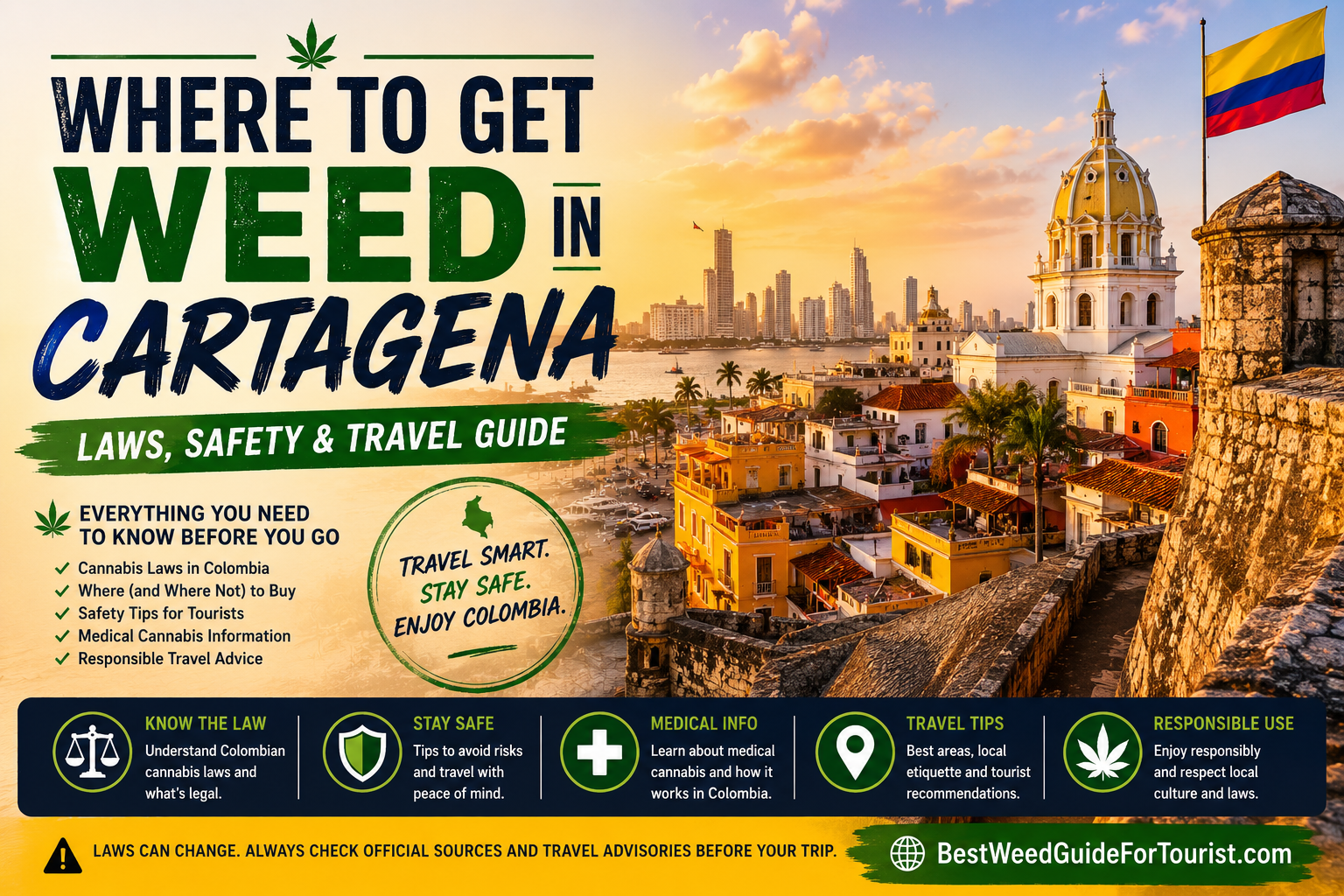
Planning a trip to Colombia’s Caribbean coast and wondering where to get weed in Cartagena? Before making decisions about cannabis during your visit, it is important to understand Colombian law, the distinction between personal possession and commercial sales, and the practical safety considerations that affect international travelers. Cartagena is known for its historic walled city, Caribbean atmosphere, colorful colonial architecture, beaches, restaurants, and lively cultural scene. Understanding local regulations before arriving can help you make informed decisions and enjoy your trip with greater confidence.
BestWeedGuideForTourist.com provides destination-focused information for travelers researching cannabis regulations, medical cannabis, and responsible tourism. This guide explains the legal distinctions visitors should understand, how to assess online claims about local availability, and which safety precautions can help reduce avoidable risks. It does not verify individual recreational sellers or guarantee that a particular transaction is lawful.
Whether you are visiting Cartagena for a short holiday, working remotely, or exploring Colombia as part of a longer South American trip, use this guide to research the rules before making decisions. Laws, enforcement practices, and local restrictions can change, so official information should always take priority over informal recommendations.
Understanding Cannabis in Cartagena, Colombia
Cartagena is a major tourist destination in northern Colombia. Visitors may encounter cannabis-related advertisements, informal offers, or discussions about Colombia’s approach to personal possession. However, the presence of an offer does not prove that a seller is authorized, that a product is genuine, or that a particular activity is permitted.
When researching where to get weed in Cartagena, separate three issues: personal possession, recreational commercial supply, and legally regulated medical cannabis. These categories can have different rules and consequences. Understanding the differences is particularly important for foreign visitors who may be unfamiliar with Colombian law.
Is weed legal in Cartagena?
The answer depends on the activity, the circumstances, and the applicable restrictions. Colombia recognizes a distinction between a personal-use dose and commercial distribution, but this does not create a general, unrestricted recreational retail market.
Colombia’s Law 30 of 1986 defines a personal-use quantity of marijuana as no more than 20 grams. The legislation also distinguishes personal use from possession intended for sale or distribution. This threshold should not be interpreted as permission to sell cannabis, consume it anywhere, or disregard other applicable restrictions. See the official legal text of Law 30 of 1986.
Public consumption and possession may also be subject to restrictions under Colombia’s National Police and Coexistence Code. The law identifies particular public areas, including parks, educational surroundings, and certain locally designated areas, where relevant conduct may be restricted. Local rules and current legal interpretations matter, so visitors should not assume that personal possession automatically authorizes public consumption. See Law 1801 of 2016.
Does personal possession mean recreational cannabis is sold legally?
No. This is one of the most important distinctions for travelers to understand. A personal-possession rule is not the same as a legal retail system that authorizes businesses to sell recreational cannabis to visitors.
The legality of a transaction can depend on the applicable rules governing supply, distribution, licensing, and the circumstances of the conduct. A person advertising cannabis on social media or approaching tourists in a public place should not automatically be treated as an authorized seller.
Before relying on a claim that recreational cannabis is legally available, verify the current legislation and the status of any proposed reforms through official Colombian sources.
Could Colombian cannabis laws change?
Cannabis policy continues to be discussed in Colombia. In July 2026, Colombia’s House of Representatives listed legislative proposal 017/2026C, concerning constitutional changes related to adult-use cannabis regulation, in its 2026–2027 legislative session. A proposal being introduced or considered is not the same as a law that has completed the legislative process and entered into force.
Travelers should check the proposal’s current status rather than assume that a headline about legalization means commercial recreational sales are permitted. The House of Representatives’ cannabis regulation page provides a starting point for checking legislative developments.
Where to Get Weed in Cartagena: What Tourists Should Know
The search phrase “where to get weed in Cartagena” can return commercial pages, social media profiles, forum discussions, and informal offers. The quality of that information varies, and some claims may be outdated or impossible to verify.
A responsible travel guide should help readers assess legal and safety questions before considering any offer. The following steps can help you avoid relying on assumptions.
1. Research the law before relying on local claims
Start with current national legislation and relevant official guidance. Look for the date of the document and whether it describes an enacted law, a court ruling, a local restriction, or a proposed amendment.
A statement that cannabis has been decriminalized in certain circumstances does not establish that all forms of possession, use, sale, or distribution are permitted. Likewise, a statement about medical cannabis does not establish recreational availability.
2. Distinguish medical access from recreational supply
Colombia has a regulatory framework for medical and scientific cannabis. The Ministry of Justice publishes information on relevant legislation, licences, and regulatory requirements, including Law 1787 of 2016 and Decree 811 of 2021.
That framework should not be confused with unrestricted recreational sales. The legal status of a particular product and transaction depends on the applicable rules and authorizations.
If you use cannabis-based medicine, consult your healthcare professional and verify local requirements before traveling. You can start with the Colombian Ministry of Justice’s official cannabis regulations page.
3. Be cautious about informal offers
An online advertisement or message may claim that a seller is trusted, licensed, or popular with tourists. Those claims should not be accepted without independent verification.
Avoid sending money to unknown contacts based only on photographs, testimonials, or promises. Do not share passport images, payment details, hotel room numbers, or unnecessary personal information with people you cannot verify. Never agree to carry packages for strangers.
If an interaction makes you uncomfortable or someone pressures you to proceed, leave the situation and seek help from your accommodation or local authorities when appropriate.
4. Understand restrictions on public spaces
Cartagena’s historic center, public parks, beaches, plazas, and other shared spaces have their own rules and may be subject to specific restrictions. Tourist popularity does not exempt a location from Colombian law.
Do not assume that cannabis can be consumed in public because other people appear to be doing so. Check the rules that apply to the specific place, respect signage and local directions, and follow the policies of your accommodation and any private venue.
Cannabis Laws in Cartagena: Important Legal Distinctions
Understanding Colombian cannabis law requires looking beyond a single quantity or a simplified statement that cannabis is legal or illegal.
Personal possession and the personal-use dose
Colombia’s Law 30 of 1986 defines a personal-use dose for marijuana as no more than 20 grams. That definition is relevant to the country’s legal framework, but it does not settle every question about possession or use.
The purpose of possession, the surrounding circumstances, applicable constitutional decisions, public-space restrictions, and other legal provisions may be relevant. The quantity alone should not be treated as a universal guarantee against police action or other consequences.
Visitors should avoid carrying cannabis across international borders or assuming that rules governing domestic possession also authorize importation or exportation.
Commercial sale and distribution
Personal possession and commercial distribution are separate legal issues. The personal-use definition does not establish that a person may sell cannabis without the necessary legal authorization.
Visitors should be especially careful about offers that claim there are no legal restrictions on sales to foreigners. Before relying on such claims, check current law and consult a qualified Colombian legal professional if the circumstances are important to you.
Public consumption
Colombian law provides for restrictions on psychoactive-substance consumption and related conduct in certain public areas. The National Police and Coexistence Code includes provisions relating to schools, sports facilities, parks, and other designated spaces. The precise application of these provisions can depend on the relevant legal interpretation and local rules.
For tourists, the practical lesson is simple: do not assume public consumption is permitted in Cartagena’s streets, beaches, parks, plazas, or historic areas. Verify the current restrictions and follow instructions from the responsible authorities.
Medical cannabis
Medical cannabis is governed by a distinct regulatory framework. Depending on the product and circumstances, rules may address licensing, production, distribution, prescriptions, and authorized uses.
If you require a cannabis-based medicine, confirm its legal status and the requirements that apply to your treatment. Do not assume that a product sold informally is an approved medicine or that a prescription from another country automatically permits you to import it into Colombia.
Staying Safe During Your Cartagena Visit
Personal safety is important in any unfamiliar destination. Cannabis-related encounters can introduce additional uncertainty when they involve unknown contacts, unverified products, or unfamiliar locations.
Choose accommodation carefully
Research your accommodation and neighborhood before booking. Read recent reviews, confirm the property’s location, and ask about guest policies and transportation arrangements.
Cartagena contains historic, residential, commercial, and tourist areas with different conditions. Do not assume that every location is equally suitable at all hours. Check current travel advice and follow guidance from your accommodation.
Use reputable transportation
Arrange transport through established services or your accommodation where possible. Confirm the vehicle and driver before entering, and keep your destination and important contact details accessible.
Avoid accepting unsolicited rides from strangers or changing your plans because someone promises a quick, inexpensive alternative. If you feel unsafe, prioritize leaving the situation rather than continuing an uncomfortable interaction.
Protect your money and identity
Keep your passport secure and carry only the identification and payment methods you need. Be wary of strangers who request advance payments, ask to photograph identity documents, or pressure you to reveal your hotel or travel plans.
When using payment applications, verify the recipient and transaction details. Never share verification codes or banking credentials with someone offering an informal service.
Avoid impaired driving
Do not drive or operate a vehicle while impaired by cannabis, alcohol, medication, or another substance. Impairment can affect attention, reaction time, judgment, and coordination.
If you are taking medication that may cause drowsiness, ask a qualified healthcare professional about its effects. Arrange a sober and reliable transport option whenever there is any uncertainty.
Check travel advisories
Security conditions can change, and advice may vary by area. Consult current travel information from your own government’s foreign affairs department and follow any local instructions relevant to your itinerary.
The U.S. Department of State’s Colombia travel advisory is one source of information for travelers. Visitors of other nationalities should consult their own government’s equivalent guidance.
Medical Cannabis and International Travel
Some visitors search for cannabis information because they use a medicine containing cannabis-derived ingredients. Their needs differ from those of travelers seeking recreational products.
Consult your healthcare professional
Discuss your trip with the clinician who manages your treatment. Ask whether you can safely travel without your usual product, whether an alternative is appropriate, and what documentation may be needed.
Do not stop a prescribed treatment or replace it with an unverified product based on informal advice from a travel website or social media contact.
Check import and transit rules
Before bringing a cannabis-based medicine into Colombia, verify the requirements for the exact product, its ingredients, and its legal classification. Check the rules for each country where you will transit as well as your destination.
A prescription from your home country does not automatically establish permission to carry a controlled substance internationally. If the product’s status is unclear, obtain official clarification before departure.
Keep documentation available
Where carrying a medicine is lawful, retain its original packaging and any prescription or supporting documents required by the authorities. Confirm whether additional authorization is necessary.
Documentation is useful, but it should not be treated as a substitute for complying with import, possession, and transport requirements.
How to Evaluate Cannabis Information Online
Search engines can return a mixture of government information, news reporting, personal accounts, commercial advertisements, and pages that have not been updated in years. A careful approach helps distinguish reliable information from unsupported claims.
Check the publication date
Look for the date an article was published and whether it has been reviewed since. If the topic involves legislation, confirm the latest position with a primary source.
A page written before a legal amendment may no longer accurately describe the rules. An article that mentions a proposed reform should also explain whether the measure has actually become law.
Prefer official sources
Legislation, official registers, government regulatory publications, and formal travel advisories are useful starting points. News reports can provide context, but important legal claims should be checked against the relevant documents.
For Colombian cannabis regulations, begin with the Ministry of Justice, the official legal information portal, and the relevant legislative bodies.
Look for evidence rather than promises
Claims such as “completely legal for every tourist” or “no risk anywhere” should be treated cautiously. Legal requirements depend on the activity and circumstances, and a website cannot guarantee how every situation will be handled.
Likewise, a seller’s use of the words “licensed,” “medical,” or “verified” does not prove that the claim is accurate. Seek independent confirmation where authorization matters.
Separate personal experiences from legal advice
Travel forums can offer practical accounts of other visitors’ experiences, but those accounts are not a reliable statement of current law. A person describing an uneventful experience does not establish that the same conduct is lawful for everyone.
Use personal experiences as context, not as a substitute for official information or qualified legal advice.
Making the Most of Your Cartagena Trip
Cartagena offers much more than its nightlife. Visitors can explore the historic walled city, learn about the city’s colonial history, discover Colombian Caribbean cuisine, and enjoy cultural activities and guided excursions.
Explore the historic center responsibly
The walled city and its surrounding historic areas contain important cultural sites, public streets, restaurants, and visitor attractions. Research opening hours and local guidance before visiting, and respect restrictions that apply to public spaces and historic locations.
A guided walking tour can help you understand the city’s architecture and history while providing practical orientation.
Plan excursions in advance
If you intend to visit nearby islands, beaches, or other destinations, confirm transport arrangements, booking terms, and weather conditions. Use established operators and keep your return plans clear.
Do not let an informal offer distract you from checking the credentials of a service provider or understanding what a booking includes.
Respect local customs and venue policies
Hotels, restaurants, bars, tour operators, and private properties may have rules concerning smoking, prohibited substances, noise, and guest behavior. Check those rules before assuming that an activity is allowed.
Being considerate of residents and other visitors helps protect your travel experience and reduces unnecessary disputes.
Keep essential information accessible
Save your accommodation details, travel insurance information, emergency contacts, and the contact information for your embassy or consulate. Keep copies of essential travel documents in a secure location.
These preparations are useful for every traveler, regardless of whether cannabis is part of the reason for researching the destination.
Why Use BestWeedGuideForTourist.com?
BestWeedGuideForTourist.com aims to help international travelers understand cannabis-related travel questions in the context of each destination. For Cartagena, useful information means explaining the difference between personal possession, commercial supply, medical regulation, and restrictions on public spaces.
Destination-specific information
Legal rules differ between countries and may also involve local restrictions. A guide focused on Cartagena can help readers identify the Colombian sources they need rather than relying on assumptions based on laws elsewhere.
Clear explanations of legal distinctions
A statement about a personal-use dose is not the same as confirmation that recreational sales are legal. Similarly, a medical cannabis framework does not automatically authorize every product or transaction.
Our guide structure emphasizes these distinctions so readers can ask better questions and verify important details.
A focus on safety and transparency
Responsible travel content should identify uncertainty rather than promise risk-free outcomes. Unverified sellers, informal payment requests, and outdated legal claims should not be presented as reliable recommendations.
Readers are encouraged to check primary sources and obtain professional advice where necessary.
Practical help for international visitors
Travelers may face language barriers, unfamiliar legal terminology, and restrictions that differ from those at home. They may also need to consider rules that apply during transit or when returning to their country of residence.
Our goal is to make the research process clearer and help visitors prepare before departure.
Frequently Asked Questions About Where to Get Weed in Cartagena
Is weed legal in Cartagena, Colombia?
Colombian law distinguishes personal-use possession from commercial distribution and also provides for restrictions on certain public-space activities. The personal-use definition in Law 30 of 1986 should not be interpreted as unrestricted permission to buy, sell, or consume cannabis anywhere. Check current law and local rules before acting.
Where can tourists buy weed in Cartagena?
This guide does not verify recreational sellers or claim that a particular location is authorized to sell cannabis. Travelers should first verify what is permitted under current Colombian law. Medical cannabis access follows a separate regulatory framework, and product-specific requirements may apply.
How much cannabis is considered a personal-use dose in Colombia?
Law 30 of 1986 defines a personal-use dose of marijuana as no more than 20 grams. However, quantity alone does not resolve every legal question. The purpose of possession, circumstances, and other applicable restrictions can matter, and the threshold does not authorize commercial sale.
Can tourists smoke weed on Cartagena’s beaches?
Do not assume that public consumption is permitted. Colombian law includes restrictions affecting certain public areas, and local rules may apply to particular places. Check current official guidance and respect posted restrictions rather than relying on what other visitors appear to be doing.
Can I bring medical cannabis into Colombia?
Do not assume that a prescription from another country automatically authorizes importation. Requirements depend on the product and applicable rules. Verify the status of the medicine with the relevant Colombian authorities and check all transit-country requirements before traveling.
Is medical cannabis the same as recreational cannabis?
No. Medical cannabis is subject to a distinct framework that can involve authorization, licensing, prescription, and dispensing requirements. That framework does not establish that recreational products can be sold freely to visitors.
Is it safe to respond to cannabis offers from strangers?
Unverified offers can carry personal, financial, and legal risks. Avoid sending money or identity documents to unknown contacts, meeting in unfamiliar places under pressure, or carrying packages for other people. If an interaction feels unsafe, leave and seek appropriate assistance.
Where can I check the latest Colombian cannabis laws?
Start with the Colombian Ministry of Justice, the official legal information portal, and the relevant legislative bodies. For practical security information, consult your government’s current Colombia travel advisory. For advice about an individual legal situation, speak with a qualified Colombian lawyer.
Conclusion: Prepare Before You Travel to Cartagena
If you are searching for where to get weed in Cartagena, begin by understanding the difference between personal possession, commercial sales, medical cannabis, and public-consumption restrictions. Colombia’s legal framework is more nuanced than a simple statement that cannabis is either legal or illegal, and legislative proposals should not be confused with laws that are already in force.
Avoid relying on unverified sellers, outdated articles, or promises that an activity is risk-free. Check official sources, review current travel advisories, and verify any medical or legal requirements that apply to your circumstances.
Cartagena has a rich cultural heritage, Caribbean atmosphere, historic architecture, and many opportunities for memorable travel. Prepare thoughtfully, respect local rules, and make informed decisions throughout your visit.
Planning your next trip? Explore more destination guides at BestWeedGuideForTourist.com, verify important information through authoritative sources, and put personal safety and legal compliance first.
Leave a Reply